
Knowing what a theatre script is is essential to understand how a play is organized before it reaches the stage. A theatre script is not just a text with dialogue; it also works as a guide for actors, directors and the technical crew. It sets out the characters, the scenes, the actions, the emotions and the instructions needed to perform a story in front of an audience.
This type of text is used in school plays, professional productions, acting workshops, creative writing exercises and stage productions. That is why knowing its structure helps both those who want to write a play and those who need to analyze, rehearse or perform it.
You may also be interested in: How to take beautiful photos: an easy guide to improve your images

What a theatre script is and what it is for
Before writing a play, it is important to understand what a theatre script is and what its role is within theatre. This document lets you organize the story, order the scenes and define what each character must say or do. Without a clear script, the performance can lose coherence, rhythm and dramatic sense.
A theatre script works as the basis for everyone involved in a play. Actors use it to learn their lines and movements; the director uses it to plan the staging; and the technical crew consults it to coordinate lights, sounds, entrances, exits or set changes.
| Element | Role within the theatre script |
|---|---|
| Characters | Indicate who takes part in the story. |
| Dialogue | Shows what each character says. |
| Stage directions | Explain actions, gestures, emotions or movements. |
| Scenes | Order the main moments of the play. |
| Acts | Divide the play into larger parts. |
| Conflict | Gives meaning to the story and drives the action forward. |
A simple definition of a theatre script
A simple way to explain what a theatre script is is to say that it is a text written to be performed on stage. Unlike a short story or a novel, it does not focus so much on narrating what happens, but on showing it through dialogue, actions and stage directions.
In a theatre script, the characters speak directly. Their words reveal the story, their emotions and the conflicts they face. The text also includes indications in brackets or on separate lines to signal gestures, movements, tones of voice, silences or changes of setting.
In simple terms, a theatre script must answer three basic questions:
- Who takes part: the characters in the play.
- What happens: the situation, the conflict or the story.
- How it is performed: the dialogue, actions and stage directions.
Why the theatre script matters in a play
The theatre script matters because it organizes every element of the performance. A play does not depend only on good characters or good dialogue; it also needs a clear structure that indicates when each scene takes place, what conflict unfolds and how the action moves forward.
When you understand what a theatre script is, it is easier to see that this text works as a map. It guides the actors, helps the director make decisions and allows the play to keep a logical sequence from beginning to end. That is why even a simple story needs a well-organized script.
A good theatre script helps to:
- Keep the story in order.
- Avoid confusion during rehearsals.
- Clearly define what each character says.
- Signal important movements, emotions and actions.
- Coordinate the work between actors, direction and technical crew.
- Give rhythm to the play so the audience can follow it better.
7 essential keys to understanding what a theatre script is
To understand what a theatre script is, it is worth reviewing its most important elements. These 7 keys sum up what a script needs so the story can be understood, rehearsed and performed clearly. They also help distinguish a theatre text from other types of writing.
Below we explain the basic components that form part of most theatre scripts, from the definition to the practical examples that let you picture how a scene is written.
You may also be interested in: 5 Tips for a Successful Event Streaming

1. Definition of the theatre script
The first key is understanding the definition. A theatre script is a text that organizes a play so it can be performed. It includes characters, dialogue, scenes, actions and stage directions. Its purpose is to turn a written story into a stage experience.
When someone searches for what a theatre script is, they usually need a clear and useful explanation. That is why the definition should always relate to live performance, since that is the main feature that sets theatre apart from other narrative formats.
2. Characters
The characters are those who take part in the story. Each one has a role within the play: they may start the conflict, face it, resolve it or show a different stance towards what happens. In the script, their names usually appear before each line to indicate who is speaking.
For a character to work well, giving them a name is not enough. It is also worth defining what they want, how they speak, what problem they face and how they relate to the other characters.
3. Dialogue
Dialogue is a central part of theatre. Through it, characters express ideas, emotions, desires and conflicts. Instead of explaining everything with narration, the theatre script lets the story move forward through what the characters say and do.
Theatre dialogue should sound natural, but also have purpose. Every line should contribute something: reveal information, show tension, create rhythm or change the direction of the scene.
4. Stage directions
Stage directions are indications that help perform the play better. They can signal movements, gestures, tones of voice, silences, entrances, exits, lights, sounds or changes on stage. Their goal is to guide, not to replace the acting.
For example, a stage direction can indicate that a character enters nervously, looks towards the door or speaks quietly. These details help the text be clearer during rehearsals and staging.
5. Scenes and acts
Scenes and acts serve to organize the play. A scene usually changes when a character enters or exits, when the location changes or when the dramatic situation shifts. An act, on the other hand, groups several scenes within a larger part of the story.
This division gives the script order. It also helps the audience follow the development of the play better, especially when the story has several important moments.
6. Conflict or dramatic situation
Conflict is the problem, tension or desire that drives the story. Without conflict, the play can feel flat, because the characters have no strong reason to act or speak. It can be a disagreement, a secret, a difficult decision or a goal someone wants to reach.
Every theatre script needs a clear dramatic situation. This situation is what gives the dialogue meaning and moves each scene towards a consequence.
7. Practical examples
Practical examples help you better understand what a script looks like in reality. When someone searches for theatre script examples, they usually want to see how characters, dialogue and stage directions are written within a simple scene. That is why it is worth reviewing several short cases to identify the structure more easily.
Below you will find four simple examples of a theatre script. Each one shows a different situation: mystery, comedy, family conflict and a school scene.
Example 1: Mystery scene
Title of the play: The closed door
Characters: Ana and Luis
Scene: A small living room. There is a door at the back.
- ANA: Did you hear that noise?
- LUIS: Yes, it came from the door.
- ANA: I don’t want to open it.
- LUIS: Then let’s wait. Maybe someone will speak first.
- ANA: (looking towards the door) And what if it isn’t someone we know?
- LUIS: (quietly) Then we’ll have to decide what to do.
In this example there is a clear conflict: the characters hear a noise and do not know whether to open the door. Stage directions also appear, indicating action and tone.
Example 2: Comedy scene
Title of the play: The surprise test
Characters: Mateo and Clara
Scene: A classroom before the test begins.
- MATEO: Clara, tell me you studied.
- CLARA: I studied.
- MATEO: Really?
- CLARA: Yes, I studied how to stay calm when you haven’t studied at all.
- MATEO: (nervous) That doesn’t help.
- CLARA: It helps more than staring at the sheet as if it were going to answer you.
Here the dialogue creates humour. The stage direction “nervous” helps you understand how Mateo should act during the scene.
Example 3: Family conflict scene
Title of the play: The last call
Characters: Mother and daughter
Scene: The kitchen of a house. There is a suitcase by the door.
- MOTHER: Are you leaving without saying anything?
- DAUGHTER: I left you a note.
- MOTHER: A note doesn’t replace a conversation.
- DAUGHTER: (looking at the floor) I didn’t know how to say it.
- MOTHER: You could have started by telling the truth.
- DAUGHTER: The truth is I need to try on my own.
This example shows a more emotional dramatic situation. The conflict appears in the daughter’s decision and in the mother’s reaction.
Example 4: School scene
Title of the play: Teamwork
Characters: Sofía, Diego and Teacher
Scene: A classroom during a group presentation.
- TEACHER: Who will start the presentation?
- SOFÍA: Diego had the introduction.
- DIEGO: I thought Sofía had it.
- SOFÍA: (surprised) Didn’t you check the document?
- DIEGO: I checked… the title.
- TEACHER: Then we’ll start with an unexpected lesson: organization.
This example is useful for students because it shows an everyday scene, easy to perform and with a simple conflict.
| Example | Type of scene | What it helps identify |
|---|---|---|
| The closed door | Mystery | Conflict, tension and stage directions |
| The surprise test | Comedy | Natural dialogue and humorous tone |
| The last call | Family drama | Emotion, conflict and dramatic pause |
| Teamwork | School | Characters, situation and purpose of the scene |
These examples make it clearer what a theatre script is, because they show how the text combines characters, dialogue, stage directions and conflict. They also help you see that a theatre script does not only say what the characters talk about, but also how the scene should be performed in front of the audience.
What a script is and how it differs from a theatre script
To better understand what a script is, you first need to know that the word “script” can apply to different formats. There are scripts for film, television, radio, videos, podcasts, presentations, ads and theatre. They all serve a similar purpose: to organize what is going to be said, shown or performed.
The difference lies in the medium it is written for. An audiovisual script is designed for cameras, shots, editing and recorded sound. A theatre script, on the other hand, is designed for the live stage, where actors move in front of the audience and the story takes place in a shared physical space.
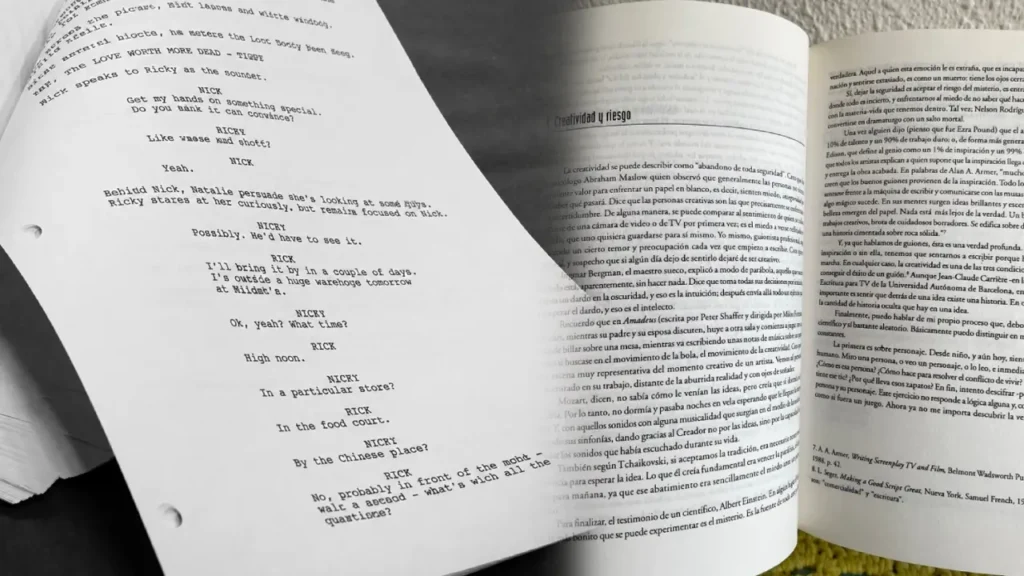
The difference between a literary script, an audiovisual script and a theatre script
A literary script can focus on narration, characters and the development of a written story. It may have broader descriptions and be intended for reading or adaptation. An audiovisual script, on the other hand, includes scenes designed for the camera, visual movements, dialogue, sounds and actions that will later be recorded or edited.
The theatre script stands out because it is designed for stage performance. In it, dialogue carries a lot of weight, stage directions indicate movements or emotions, and the structure is usually divided into acts and scenes.
| Type of script | Where it is used | Main feature |
|---|---|---|
| Literary script | Short stories, novels or narrative texts | Describes a story to be read or adapted. |
| Audiovisual script | Film, television, videos or commercials | Includes actions designed for camera, sound and editing. |
| Theatre script | Plays or stage performances | Written to be performed live in front of an audience. |
When each type of script is used
Each type of script is used according to the goal of the project. If a film, video or commercial is going to be shot, an audiovisual script is the right choice. If an oral presentation is being organized, a simpler script may be enough. If the story will be acted on a stage, then a theatre script is needed.
This distinction helps avoid confusion. Not all scripts are written the same way, because not all of them are executed in the same format. Understanding what a script is lets you choose the right structure and adapt the content to the medium where it will be presented.
As a practical rule:
- Use a theatre script if the story will be acted on a stage.
- Use an audiovisual script if the story will be recorded with a camera.
- Use a literary script if the story is mainly intended for reading.
- Use a presentation script if you need to organize ideas to speak in front of an audience.
Main parts of a theatre script
To better understand what a theatre script is, it is important to know the parts that make it up. Each element has a role within the play and helps the text be read, rehearsed and performed clearly. Although some scripts may vary according to the author’s style, most include a title, characters, dialogue, stage directions, scenes and acts.
These parts give the story order. They also help the actors know when to speak, how to move and what intention each moment of the scene should have.
| Part of the theatre script | Main role |
|---|---|
| Title | Identifies the play. |
| List of characters | Introduces who takes part in the story. |
| Dialogue | Indicates what each character says. |
| Stage directions | Signal actions, gestures, emotions or movements. |
| Scenes | Divide the moments of the play. |
| Acts | Group scenes within a larger structure. |
Title of the play
The title is the reader’s first reference to the play. It can be direct, symbolic, mysterious or descriptive, but it should relate to the story, the conflict or the main theme. A good title helps create expectation and gives the theatre script its identity.
For example, titles such as The closed door, The last rehearsal or A night without answers already suggest a tone or a situation before you read the first scene.
List of characters
The list of characters usually appears at the start of the script. It serves to introduce those who take part in the story and, in some cases, to include a brief description of each one. This information helps the director, the actors and the reader understand who is involved in the play.
A simple example would be:
| Character | Brief description |
|---|---|
| Ana | A curious, observant student. |
| Luis | A nervous but loyal friend. |
| Teacher | An authority figure who guides the scene. |
Dialogue
Dialogue is one of the most important parts when explaining what a theatre script is, because theatre moves forward mainly through what the characters say. Every line should have intent: to inform, to move, to create tension, to show personality or to push the conflict forward.
Theatre dialogue should not feel like a long, artificial explanation. Ideally it should sound natural, while at the same time contributing something important to the scene.
Stage directions
Stage directions are instructions that appear within the script to indicate actions, emotions, movements, pauses, sounds or set changes. They are usually written in brackets or in italics, depending on the format used.
For example:
- MARTA: (looking out of the window) I think someone followed us.
- DIEGO: Don’t say that.
- MARTA: (quietly) Then explain to me why the door is open.
In this case, the stage directions help convey the tone, the gesture and the tension of the scene.
Scenes and acts
Scenes divide the play into specific moments. A scene can change when a character enters, when the location changes or when a new situation appears. Acts, on the other hand, group several scenes and are usually used in longer plays.
This division helps keep the rhythm. It also makes it easier to organize rehearsals, set changes and the progression of the story.
Features of a theatre script
Beyond its parts, it is also useful to know the features that make this type of text different. When studying what a theatre script is, you understand that it is not written only to be read, but to be performed live in front of an audience.
That is why a theatre script must be clear, orderly and functional. It has to allow the actors to interpret the story and the technical crew to understand the key moments of the staging.
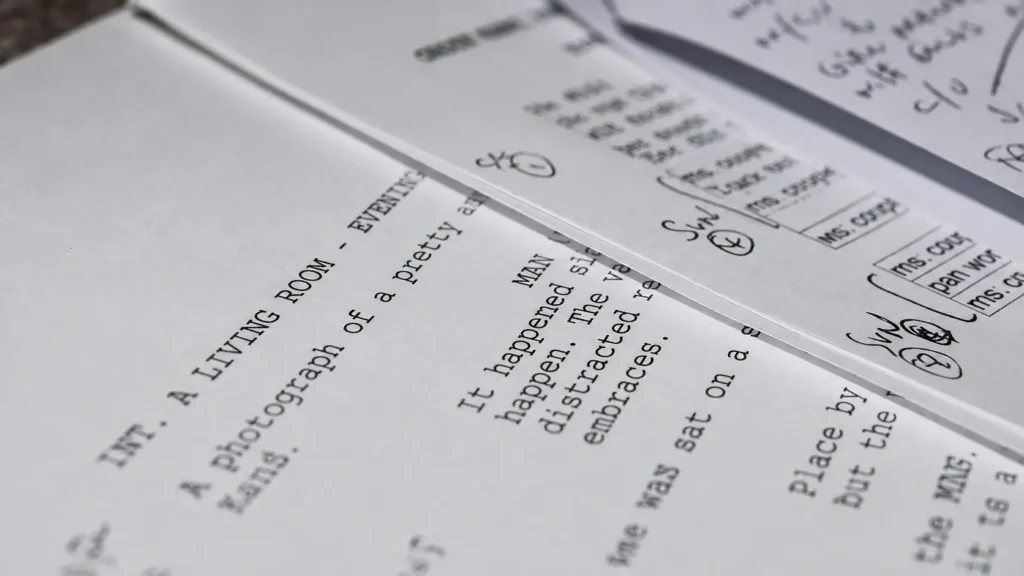
The use of direct dialogue
Direct dialogue is a central feature of the theatre script. Each character speaks for themselves, without a narrator explaining everything that happens. This makes the story feel alive and lets the audience discover the conflicts through the characters’ words and actions.
Good dialogue must sound believable. If every character speaks the same way, the play loses strength. Each character should have a way of expressing themselves that matches their age, personality, context and goal within the story.
Directions for actors and stage
Another important feature is the directions for performance. These instructions make it possible to know whether a character enters, exits, sits down, shouts, cries, stays silent or changes position on stage.
In live productions, planning movement and timing is essential. The same happens in other stage events or performances in front of an audience, such as runway shows, performances or fashion experiences, where visual organization helps each moment be better understood by the audience.
Organization by scenes or acts
Organizing by scenes or acts gives the script a clear structure. This makes reading, rehearsing and the final performance easier. A play with no divisions can feel confusing, especially if it has several characters, locations or conflicts.
When someone learns what a theatre script is, they should understand that the structure is not just a formality. It exists so the story has a beginning, a development and an ending, and so each scene serves a purpose within the whole.
How to write a theatre script step by step
After learning what a theatre script is, the next step is learning how to write one. You do not need to start with a very long story; in fact, to practise it is better to create a short scene with few characters and a clear conflict.
The key is organizing your ideas before writing the dialogue. If you know what happens, who takes part and what each character wants, it will be easier to build a scene that makes sense.
Define the story and the main conflict
Before writing, define what the play is about. It can be an argument, a difficult decision, a secret, a competition, a farewell or an unexpected situation. Conflict is what makes the scene move forward.
Examples of a simple conflict:
- A character has lost something important.
- Two friends are hiding a truth.
- A family has to make a decision.
- A student is afraid of speaking in public.
- Someone wants to leave, but another person tries to stop them.
Create the characters
The characters must have a clear role within the story. Not all of them need a long description, but they do need an intention. Ask yourself what each character wants and what obstacle they face.
An easy way to organize them is this:
| Question | Example answer |
|---|---|
| Who are they? | A student named Laura. |
| What do they want? | To hand in her work on time. |
| What problem do they have? | She can’t find her notebook. |
| How do they react? | She gets nervous and looks for help. |
Write the dialogue
Dialogue should sound natural, but it must also serve a purpose. Avoid having characters explain too much or repeat information the audience already understands. Every line should help show emotion, move the action forward or reveal something important.
A good tip is to read the dialogue out loud. If it sounds stiff, too long or unconvincing, it is worth adjusting.
Add clear stage directions
Stage directions should be useful and specific. There is no need to explain every small movement, but you should note those that help the scene make sense. A good stage direction can indicate an emotion, a pause, an entrance or an important action.
Example:
- MARIO: (avoiding her gaze) I didn’t want you to find out this way.
- ELENA: Then you should have told me the truth.
The stage direction helps show guilt or discomfort without stating it directly.
Review the final structure
Before finishing, check whether the script has a title, characters, a scene, dialogue, stage directions and conflict. Also make sure each scene has a purpose and that the ending is clear.
Quick checklist:
- Does the title relate to the story?
- Are the characters identified?
- Is the dialogue clear?
- Do the stage directions help perform the scene?
- Is there a conflict?
- Does the scene have a beginning, a development and an ending?
Common mistakes when writing a theatre script
When learning what a theatre script is, it is also useful to know the most common mistakes. These problems can make a play feel confusing, slow or difficult to perform.
Many mistakes come from a lack of structure. That is why, before writing a long play, it is worth practising with short scenes and checking whether each element serves a clear purpose.
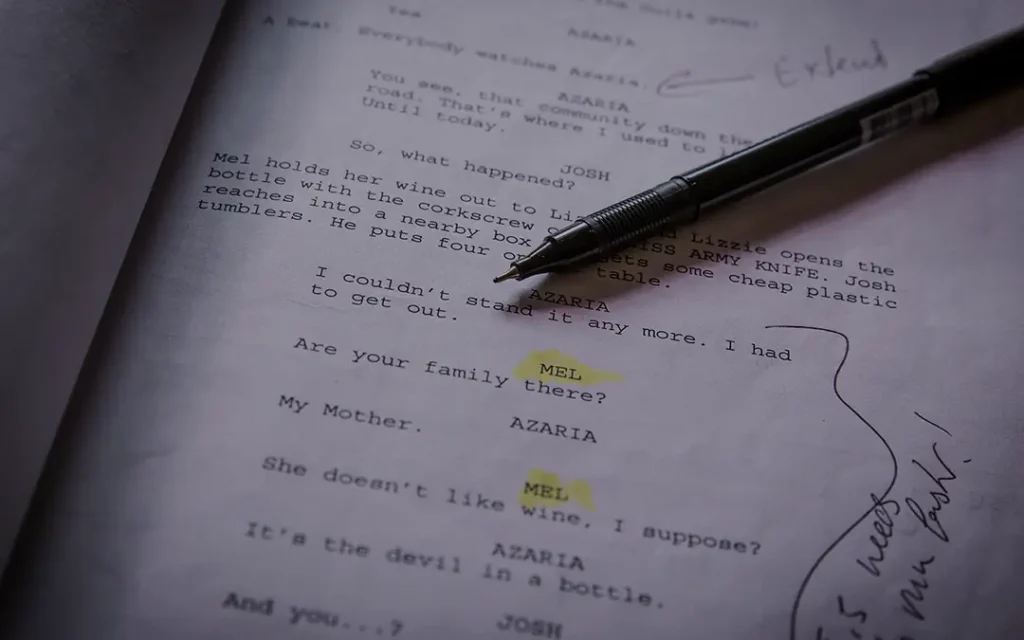
Unnatural dialogue
A frequent mistake is writing dialogue that sounds too explanatory. In real life, people do not usually say everything they think in a neat, perfect way. In theatre, dialogue must feel alive, even when it is carefully written.
Avoid overly long lines if they do not add rhythm or emotion. Also make sure each character has their own voice.
A lack of stage directions
Another common mistake is not including enough stage directions. Without minimal guidance, actors may not know how to interpret certain actions or emotions. That said, it is not a good idea to fill the script with unnecessary instructions either.
The ideal is to include clear stage directions at the important moments: entrances, exits, pauses, gestures, changes of tone or actions that affect the scene.
Scenes with no clear purpose
A scene must contribute something to the story. It can introduce a conflict, reveal information, show a decision or change the relationship between the characters. If a scene serves no purpose, it probably needs to be adjusted or removed.
A good question for reviewing is: “What changes after this scene?” If nothing changes, perhaps the scene is not helping the play develop.
Conclusion: why understanding what a theatre script is helps you write better plays
Understanding what a theatre script is helps you write, read and perform plays with greater clarity. A well-built script organizes the characters, the dialogue, the stage directions, the scenes and the conflict so the story can be presented to the audience coherently.
In short, knowing what a theatre script is is not only useful for a school assignment or a writing exercise. It also lets you understand how a play works from the inside: what the characters say, what they do on stage, what problem they face and how the action develops. The clearer the structure, the easier it will be to turn an idea into a complete theatrical performance.
Need help with your video script?
We write and produce the whole video, from concept to final delivery.
See corporate videos